

Container Home Cost: What You Will Actually Pay in 2026
Container home cost is the first question every buyer asks and the one the industry answers worst. Most sites give you a range so wide it is useless, then push you into a quote funnel. Here is the honest version: as of 2026, a factory-finished container home typically runs from around $15,000 for a 20 ft studio unit to $250,000 or more for a large custom multi-container build, and the biggest cost differences come from three decisions, not from negotiation: prefab vs custom vs DIY, size and layout, and what your site needs before the home arrives.
AnchorBox sells ready-made container buildings with the price printed on the page and real online checkout, so the numbers below are the same lens we use on our own container homes inventory.
Container Home Cost by Size and Spec
Typical US ranges as of 2026 for the unit itself, delivered but excluding site work. These are market ranges, not guarantees; exact pricing depends on finish level, appliances, and spec.
| Home type | Typical size | Typical 2026 range |
|---|---|---|
| 20 ft studio unit | ≈160 sq ft | $15,000 to $40,000 |
| 40 ft one-bedroom | ≈320 sq ft | $30,000 to $70,000 |
| 40 ft expandable or 2-bedroom layout | ≈320 to 700 sq ft | $35,000 to $85,000 |
| Multi-container (2 to 3 boxes joined) | ≈640 to 960 sq ft | $80,000 to $160,000 |
| Two-story container home | ≈700 to 1,200 sq ft | $100,000 to $200,000+ |
| Custom 3-bedroom build | ≈1,000+ sq ft | $150,000 to $250,000+ |
Prefab vs Custom vs DIY
Factory-finished prefab
The unit is built and finished in a factory, shipped as a sealed module, and set on your prepared site. This is the most predictable path on both price and timeline, because the labor happens where labor is efficient. It is also the only path where you can actually buy at a fixed price instead of collecting bids.
Custom builds
An architect or design-build firm engineers a home from multiple containers. You get real design freedom, cantilevers, big glass, cut-away walls, and you pay for it: custom projects typically land well into six figures once engineering, cutting, reinforcement, and on-site trades are counted. Every opening cut into a container removes structure that has to be replaced with welded steel, which is why custom container work costs more per square foot than people expect.
DIY conversion
You buy a one-trip high cube shell, typically $3,600 to $5,600 for a 40 ft as of 2026 (see our 40 ft containers), then insulate, frame, wire, and plumb it yourself. Materials for a livable conversion typically add $10,000 to $35,000 on top of the box, depending on finish level, before counting your time. It is a real path for skilled builders, and a slow expensive education for everyone else. Spray-foam insulation and honest electrical work are the two corners you cannot cut.
What a Factory-Finished Unit Includes
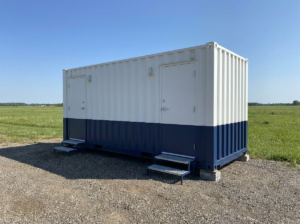
Spec sheets vary, so verify line by line, but a properly finished unit generally arrives with insulation and interior wall finishes, flooring, windows and an insulated entry door, a wired electrical panel with outlets and lighting, a plumbed bathroom, a kitchenette, and a mini-split for heating and cooling. In other words, it connects to utilities rather than needing construction. The same logic applies to our container offices, which share the platform with different interiors. Compare listings closely: two units at similar prices can differ by thousands of dollars in what is actually installed.
The Site Costs Buyers Forget
The unit price is not the project price. Budget for the ground before the home ships:
- Foundation: concrete piers or a slab, commonly a few thousand dollars depending on soil and size. Containers need support at the corner castings, which is simpler than a full conventional foundation but still an engineered detail.
- Utility connections: water, sewer or septic, and electrical service. This is the widest variable in the whole project, from modest hookup fees on a serviced lot to five figures for a new well or septic system on raw land.
- Permits and code approval: requirements vary by county and municipality, and this is the step to research first, not last. Many jurisdictions work from model codes published by the International Code Council, which has also published guidance specific to shipping containers used as buildings. Call your local building department before you order anything.
- Access: the delivery truck needs a clear path and firm ground, and multi-container or two-story sets may need a crane day.
Why Fixed-Price Units Beat Quote-Only Pricing
Most container home sellers advertise a teaser price and make you request a quote, and the quote grows once you are invested in the process. A published price you can check out against works differently: the seller has to commit before knowing anything about you. Every unit in our container buildings catalog is listed at a fixed price with free delivery and placement in all 50 US states through our regional depot partners, payable by card link or bank wire. Compare that number, all-in, against any quote you collect. If you want to sanity-check a floor plan or a site before buying, call (509) 575-1198 and ask; the phone gets answered by people who deal with these units daily.
Frequently Asked Questions
How much does a container home cost compared to a traditional house?
Per square foot, a factory-finished container home typically costs less than site-built construction in most US markets as of 2026, mainly because the labor happens in a factory. The gap narrows on large custom container projects, where structural steel work eats the savings.
Are container homes legal everywhere?
No single answer covers the US. Zoning and building codes vary by county and city, and some jurisdictions welcome container homes while others restrict them to certain zones or require engineering stamps. Confirm with your local building department before purchase.
How long does it take to get a container home livable?
For a prefab unit, the factory-to-door timeline is typically measured in weeks, and site work such as the foundation and utility hookups often runs in parallel. Custom builds typically take many months. DIY depends entirely on your pace and skills.



Add comment